


Skip to content
Logistics

Logistics, Ports & Air Cargo

Sea ports, airports, container yards and sorting lines generate more video than any network can carry and that is too costly to process in a cloud. axelera.pro puts high-performance vision inference directly where the cameras are: Read, inspect, track, all in real-time, at a fraction of the power and cost of alternative deployments.

Baggage Handling & Hold Screening Support

At an international airport, a centralized baggage system moves tens of thousands of bags an hour. Every jam, misfeed, unreadable tag or mis-sorted item becomes a mishandled-bag statistic. Vision at each induction and transfer point catches what barcode readers miss — no-read bags, oversized and out-of-gauge items, protruding straps and damage — fast enough to divert before the bag is lost to the system. Dozens of concurrent streams, sub-second decisions, and video that never leaves the airport. 
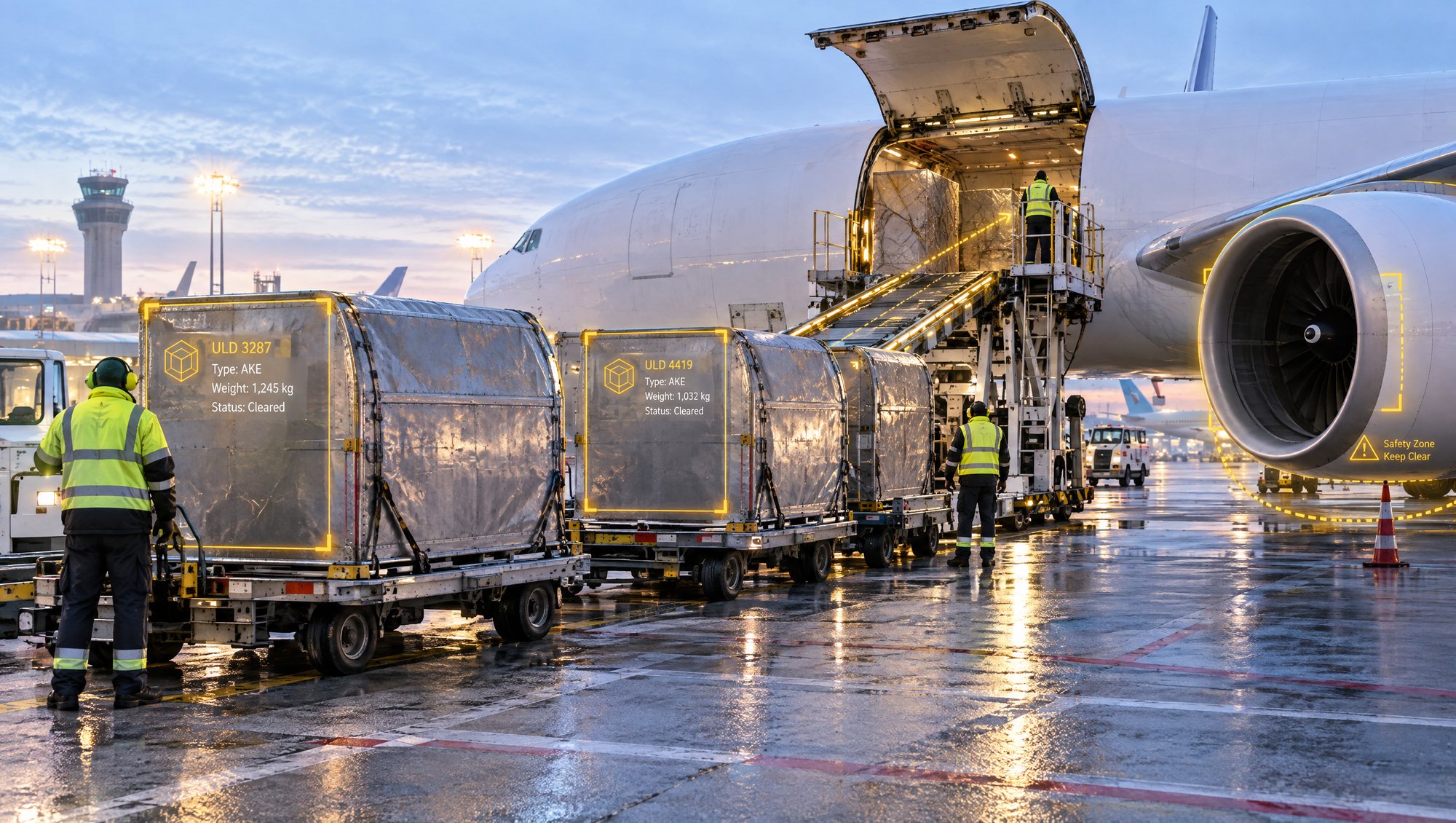
Baggage handling

Automated Inspection: Container ID & Damage Capture

 A truck should clear a terminal gate in under a minute, with the port operating knowing everything relevant about that container: container number, ISO type code, chassis ID and licence plate; all read and processed while the vehicle is still rolling. Dents, punctures, rust, bent frames and missing seals also noted and logged to that same container ID. One portal, one pass, one record that settles damage disputes and clears the lane. That means OCR (optical character recognition) and high-resolution segmentation running across a dozen synchronized camera angles at full frame rate. All processed on-site, inside a sealed fanless device that survives heat, dust and salt air, with no cloud round-trip and no bandwidth bill that multiplies with every container moved. 
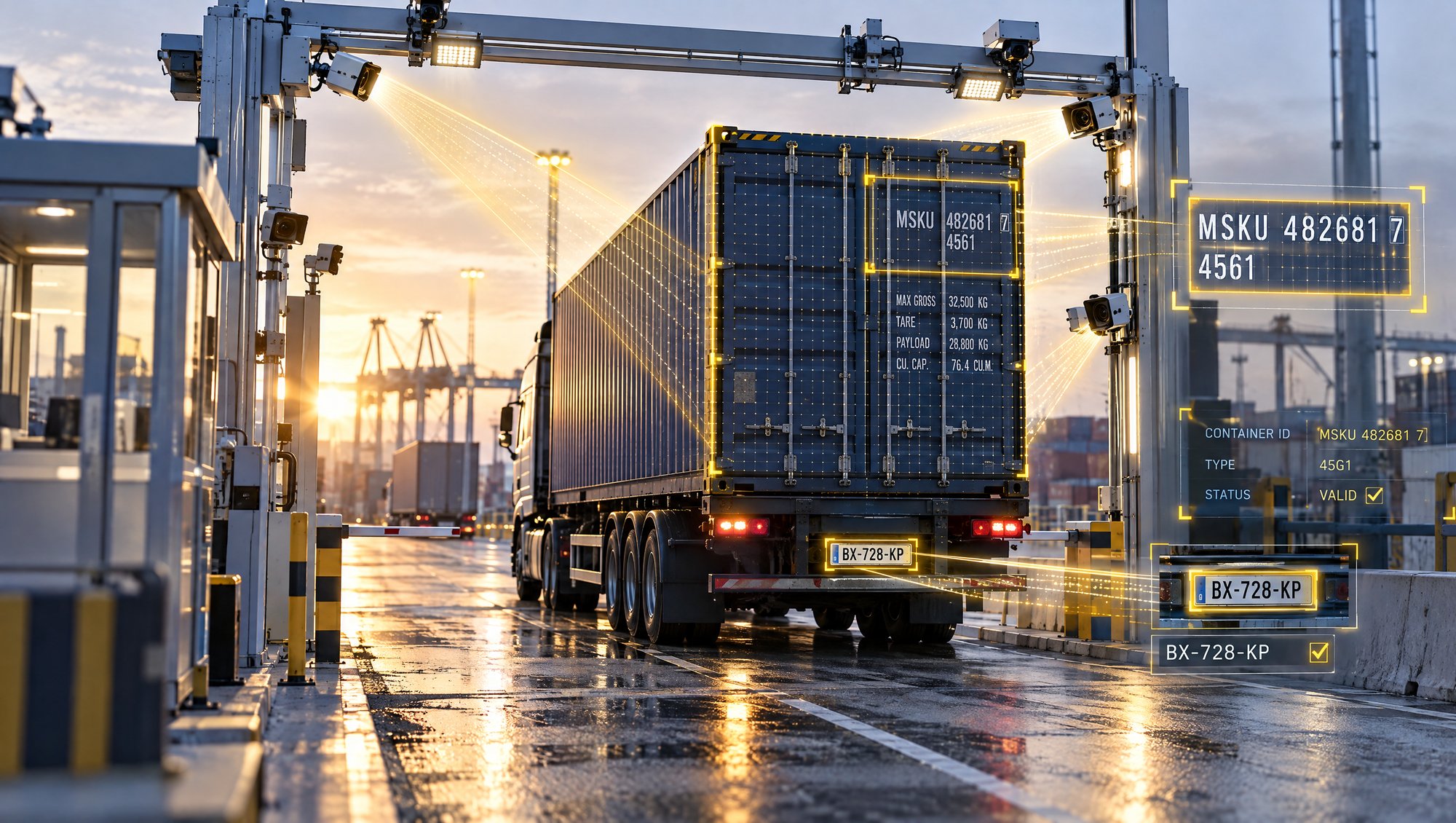
Gate entry monitoring

Crane and Yard Handling

Ship-to-shore and RTG cranes need centimetre-level awareness; spreader alignment, twist-lock state, container landing confirmation, and human awareness to recognize anyone who steps into the drop zone. Latency here is a safety property, and radio links from a moving gantry are never a guarantee. Perception has to run on the machine itself: deterministic, always available, and efficient enough to sit in a sealed cabinet with limited cooling and a tight power envelope.

Autonomous movement around a shipyard can increase time to delivery, but gridlock and containers being "stuck" is a problem no port can afford to face. Bringing real-time decision making to the AGV gives port operators more control and warning to prevent gridlock within their environment.

Container management

Package Sort and Inspection

On a fast sorter, every parcel is a few hundred milliseconds of decision: read the label, catch the damaged or leaking box, dimension the irregular item, flag the misroute before it travels tto the wrong country.

Central servers make that expensive to scale line by line. Putting inference directly on the conveyor gives each inspection point its own perception, with predictable latency and a power and cost budget that lets you replicate it across the whole facility. 
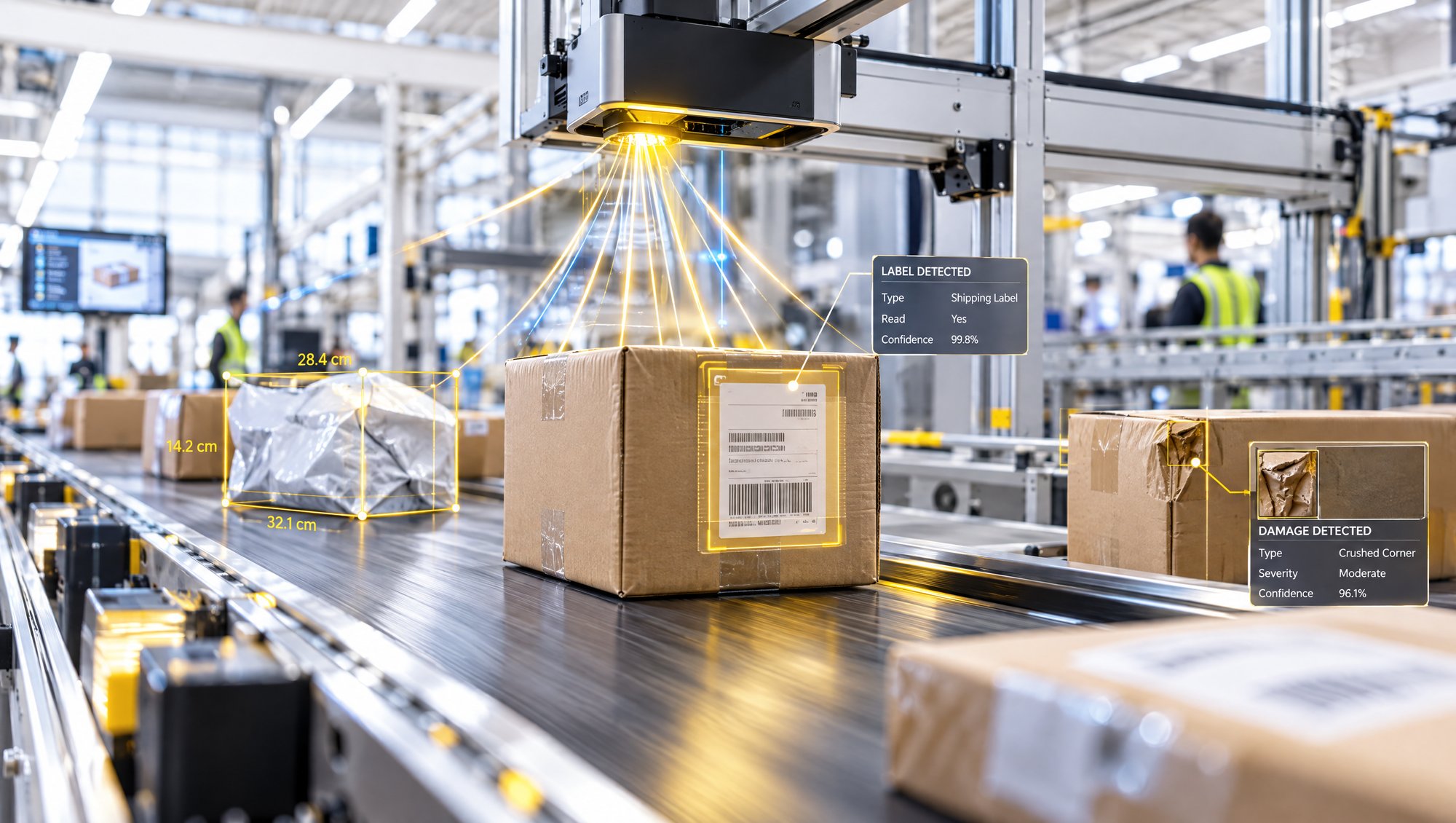
Package Inspection

Boost efficiency with AI-driven applications in manufacturing

AI-based visual inspection systems utilize machine learning algorithms to analyze and evaluate product images in real time. The applications are endless, including use cases which were simply not possible before, like real-time sorting of garbage or vegetables with a level of granularity previously unattainable without neural networks. Furthermore, these systems enable faster and more flexible Optical Character Recognition (OCR), advanced defect analysis, precise pick-and-place operations, and sophisticated 3D vision in robotic applications. Innovation on the production line is all about AI.

Smart Warehouses powered by AI

Time-motion study has been a business efficiency technique since the early 20th century. Hundred years later, video systems can provide extremely accurate insights for boosting workers productivity while protecting their privacy. The same systems can also monitor occupancy storage and traffic areas to optimize picking and packing. Autonomous Mobile Robots are redefining the way goods are moving inside a warehouse, requiring a navigation system based on 6 or more cameras to ensure reliable and safe operation. Similarly, in vertical automated warehouses, computer vision AI can help operators reduce error rates by alerting employees handpicking wrong products from the drawer, thereby improving accuracy and reducing wastage.

Next-gen AI-enabled products for machine builders

Machine builders are leveraging AI to create value for their customers and get insights on the way the machine is operating. Integrated video analytics can detect defects in real-time, improving customer satisfaction through better quality and increased productivity. Simultaneously, these systems can identify patterns in machine outputs that signal the need for maintenance before a failure occurs. Another critical area is worker safety. In 2021, the manufacturing industry had one of the highest rates of nonfatal work injuries and illnesses, surpassed only by healthcare and retail. Video analytics can enhance safety by slowing down machine speed when an operator approaches and stopping the machine if biometric data indicate that the worker is unauthorized.

Freedom to innovate

The highly energy-efficient, easy-to-integrate and future-proof axelera.pro Metis Platform accelerates equipment and software deployment by providing a comprehensive hardware and software solution for accelerating Vision AI in Industrial Manufacturing. While the hardware design enhances performance or reduces cost and power consumption, the usability of Metis makes vision AI technology accessible to a broader range of developers and enterprises worldwide, so they have the freedom to innovate.

Fabrizio Del Maffeo, CEO & Co-founder explains how axelera.pro addresses market gaps with innovative computer vision AI and AI accelerator hardware, delivering high performance and efficiency for the embedded and Edge spaces at lower power consumption.

3 reasons why Metis accelerates AI in Industrial Manufacturing

The Metis AIPU stands out by offering this transformative capability with industry leading power and cost efficiency. Voyager® SDK (link), our easy-to-use and flexible toolchain built upon open-source components, supports object detection networks like YoloV7 and YoloV8, segmentation networks like UNet, different OCR networks, and many more. It also provides full flexibility to optimize performance and customize the computer vision pipeline for the specific application.

The Metis AI platform ensures that AI in manufacturing meets the rigorous demands of industrial applications, and does so with unparalleled cost efficiency and operational reliability, all while keeping data secure onsite.

Outstanding power efficiency

Our cutting-edge chip features a power envelope of less than 15W, ensuring efficient energy usage while delivering exceptional performance. With the capability to downclock, you can fine-tune the power consumption to meet your specific needs, all while maintaining an outstanding frames-per-second per watt (fps/W) ratio. This balance of power efficiency and performance makes our chip the ideal choice for high-demand applications.

High accuracy

Our networks are automatically quantized during compilation to run efficiently and accurately on Metis. The accuracy after quantization remains comparable to the original floating-point networks. For example, two popular networks, Resnet-50 and Yolov7, each achieve quantized accuracy within 0.17% of the original 32-bit floating point models.

Cost-Effective

The Metis AIPU offers a unique blend of cost-effective and energy-efficient AI inference capabilities. Moreover, a single chip can deliver up to 214 trillion operations per second. Our Axelera Server 150p card powered by 4 Metis AIPU achieves record-breaking performance and efficiency.

Accelerate your route to market for machine vision equipment

Getting started with the Metis AI Platform is easy thanks to our end-to-end systems, based on both x86 and ARM platforms. Experience the inference and accuracy capabilities of our Metis AIPU, and work on integrating your application for some real-world benchmark. Integrating the Metis AIPU into your products will then be simplicity itself, thanks to our acceleration cards based on M.2 and PCIe standard form factors .
What’s more, our low-code Voyager SDK speeds up software development and system integration, helping you bring your industrial equipment to market fast.
Tweak one of our pre-trained AI models or develop your own – with our unique quantization method you may only need a short calibration based on a small subset of your existing dataset. Either way, our integrated systen ensures optimized end-to-end performance and the highest accuracy possible. Supporting open standards including OpenCL and SYCL, the Voyager SDK integrates seamlessly into your existing development flow for maximum ease of use.

Flexible AI hardware to support all industrial customers

Industrial Manufacturing applications come in all shapes and sizes. However, the Metis AIPU, the most scalable AI accelerator technology on the market is available, so you can easily support all your projects with a single platform. We offer single-AIPU Axelera Embedded 110m cards and an Axelera Edge 130p card, letting you balance cost and performance. Need more AI power for larger optical inspection lines or high efficiency for your embedded system? axelera.pro’s portfolio can cover all your different needs with a scalable range of products and a strong ecosystem of partner solutions.

“The exceptional performance and accuracy of the axelera.pro Acceleration platform have significantly fueled our collaborative efforts. Its unmatched performance-to-price ratio, surpassing traditional GPUs and dedicated AI processing units, has been critical in our selection process. We are confident that leveraging their state-of-the-art performances will empower us to tackle new challenges in our current and future applications.”

Alexandre Perez
R&D Director at XXII

.